Anna L Tsing Et Al Arts of Living on a Damaged Planet
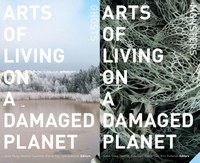
Tin can humans and other species keep to inhabit the earth together?
As man-induced ecology alter threatens multispecies livability, Arts of Living on a Damaged Planet puts forward a bold proposal: entangled histories, situated narratives, and thick descriptions offer urgent "arts of living." Included are essays by scholars in anthropology, environmental, scientific discipline studies, art, literature, and bioinformatics who posit critical and creative tools for collaborative survival in a more-than-human Anthropocene.
Arts of Living on a Damaged Planet exposes u.s.a. to the active remnants of gigantic by human being errors—the ghosts—that affect the daily lives of millions of people and their co-occurring other-than-homo life forms. Challenging us to look at life in new and excitingly unlike ways, each part of this two-sided volume is informative, fascinating, and a source of stimulation to new thoughts and activisms. I have no uncertainty I will return to it many times.
—
Michael Grand. Hadfield, University of Hawai'i at Mānoa
Living on a damaged planet challenges who nosotros are and where we live. This timely anthology calls on 20 eminent humanists and scientists to revitalize curiosity, ascertainment, and transdisciplinary conversation about life on earth.
Equally man-induced ecology change threatens multispecies livability, Arts of Living on a Damaged Planet puts forrard a assuming proposal: entangled histories, situated narratives, and thick descriptions offer urgent "arts of living." Included are essays past scholars in anthropology, ecology, science studies, art, literature, and bioinformatics who posit critical and creative tools for collaborative survival in a more-than-homo Anthropocene. The essays are organized around two primal figures that also serve as the publication's 2 openings: Ghosts, or landscapes haunted past the violences of modernity; and Monsters, or interspecies and intraspecies sociality. Ghosts and Monsters are tentacular, windy, and arboreal arts that invite readers to encounter ants, lichen, rocks, electrons, flying foxes, salmon, chestnut copse, mud volcanoes, border zones, graves, radioactive waste matter—in short, the wonders and terrors of an unintended epoch.
Contributors: Karen Barad, U of California, Santa Cruz; Kate Dark-brown, U of Maryland, Baltimore; Carla Freccero, U of California, Santa Cruz; Peter Funch, Aarhus U; Scott F. Gilbert, Swarthmore College; Deborah Chiliad. Gordon, Stanford U; Donna J. Haraway, U of California, Santa Cruz; Andreas Hejnol, U of Bergen, Norway; Ursula Thou. Le Guin; Marianne Elisabeth Lien, U of Oslo; Andrew Mathews, U of California, Santa Cruz; Margaret McFall-Ngai, U of Hawaii, Manoa; Ingrid K. Parker, U of California, Santa Cruz; Mary Louise Pratt, NYU; Anne Pringle, U of Wisconsin, Madison; Deborah Bird Rose, U of New South Wales, Sydney; Dorion Sagan; Lesley Stern, U of California, San Diego; Jens-Christian Svenning, Aarhus U.
Arts of Living on a Damaged Planet exposes u.s. to the agile remnants of gigantic past human errors—the ghosts—that affect the daily lives of millions of people and their co-occurring other-than-human life forms. Challenging us to look at life in new and excitingly dissimilar means, each function of this 2-sided book is informative, fascinating, and a source of stimulation to new thoughts and activisms. I take no doubt I will return to it many times.
—
Michael M. Hadfield, University of Hawai'i at Mānoa
Facing the perfect tempest strangely named the Anthropocene, this book calls its readers to acknowledge and requite praise to the many entangled arts of living which made this planet liveable and which are now unravelling. Grandiose guilt will not exercise, we need to learn noticing what we were blind to, a humble but difficult art. The unique welding of scholarship and affect accomplished by the texts here assembled tells us that learning this art as well means allowing oneself to be touched and induced to think and imagine by what touches united states of america.
—
Isabelle Stengers, author of Cosmopolitics I and Cosmopolitics II
What an inventive, fascinating book nearly landscapes in the anthropocene! Between these book covers, rightside-up, upside-down, a concatenation of social science and natural science, artwork and natural science, ghosts of departed species and traces of our ain human shrines to memory... Not a horror-filled glimpse at destruction only also not a hymn to romantic wilderness. Here, guided by a remarkable and remarkably diverse fix of guides, we enter into our planetary environments as they stand, sometimes battered, sometimes resilient, always riveting in their human—and not-human—richness. Arts of Living on a Damaged Planet is truly a volume for our fourth dimension.
—
Peter Galison, Harvard University
Calling a book 'mandatory reading' commonly feels hyperbolic, but it's justified in the instance of Arts of Living on a Damaged Planet. A stunning collection of essays from scientists, writers and artists on humankind's impact on the planet, and how we all can survive it.
This vibrant, moving, and philosophical two-sided essay collection reminds us of all the ways that human beings and the natural globe are interconnected. Deborah Bird Rose'south piece on the "shimmer of life" alone makes the book worth reading.
—
Chicago Review of Books
There'south a poesy in facts. And equally this volume reveals, there is an increasing amount of courage and acceptance to be constitute in understanding fifty-fifty the nigh destructive changes in institute and wild animals that the overheated Anthropocene will bring us.
Well worth reading: a frank, luminous prepare of dispatches from future worlds and fractured pasts.
Arts of Living on a Damaged Planet is a strikingly aesthetic object, advisedly curated at the level of form as well as content. It makes a convincing instance for the relevance of 'hard science' to art and politics.
—
Glasgow Review of Books
Contents
Ghosts on a Damaged Planet
Introduction: Haunted Landscapes of the Anthropocene
Elaine Gan, Nils Bubandt, Anna Lowenhaupt Tsing, and Heather Anne Swanson
1. A Garden or a Grave?: The Canyonic Landscape of the Tijuana-San Diego Region
Lesley Stern
In the Midst of Damage
two. Marie Curie's Fingerprint: Nuclear Spelunking in the Chernobyl Zone
Kate Brown
3. Shimmer: When All You Love Is Being Trashed
Deborah Bird Rose
Footprints of the Expressionless
4. Time to come Megafaunas: A Historical Perspective on the Scope for a Wilder Anthropocene
Jens-Christian Svenning
5. Ladders, Copse, Complication, and Other Metaphors in Evolutionary Thinking
Andreas Hejnol
six. No Small Thing: Mushroom Clouds, Ecologies of Nothingness, and Foreign Topologies of Spacetimemattering
Karen Barad
seven. Haunted Geologies: Spirits, Stones, and the Necropolitics of the Anthropocene
Nils Bubandt
What Remains
8. Ghostly Forms and Forest Histories
Andrew S. Mathews
9. Establishing New Worlds: The Lichens of Petersham
Anne Pringle
Coda: Concept and Chronotope
Mary Louise Pratt
Contributors
Alphabetize
Contents
Monsters and the Arts of Living
Acknowledgments
Introduction: Bodies Tumbled into Bodies
Heather Anne Swanson, Anna Lowenhaupt Tsing, Nils Bubandt, and Elaine Gan
1. Deep in Admiration
Ursula Yard. Le Guin
Inhabiting Multispecies Bodies
2. Symbiogenesis, Sympoiesis, and Art Science Activisms for Staying with the Problem
Donna Haraway
3. Noticing Microbial Worlds: The Mail service Modern Synthesis in Biology
Margaret McFall-Ngai
Beyond Individuals
four. Holobiont past Nascence: Multilineage Individuals as the Concretion of Cooperative Processes
Scott F. Gilbert
v. Wolf, or Homo Homini Lupus
Carla Freccero
half dozen. Unruly Appetites: Salmon Domestication "All the Way Downwardly"
Marianne Elisabeth Lien
7. Without Planning: The Evolution of Collective Beliefs in Pismire Colonies
Deborah K. Gordon
At the Border of Extinction
8. Synchronies at Chance: The Intertwined Lives of Horseshoe Crabs and Red Knot Birds
Peter Funch
9. Remembering in Our Amnesia, Seeing in Our Blindness
Ingrid M. Parker
Coda. Cute Monsters: Terra in the Cyanocene
Dorion Sagan
Contributors
Alphabetize
rowallanwintakephe.blogspot.com
Source: https://www.upress.umn.edu/book-division/books/arts-of-living-on-a-damaged-planet
0 Response to "Anna L Tsing Et Al Arts of Living on a Damaged Planet"
Post a Comment