Truth Lies at the Bottom of a Well Francis Art Nouveau
Most people take heard of Art Nouveau, but few remember two of the well-nigh influential figures in its conception. (No, not Gustav Klimt.) They were a pair of sisters named Margaret and Frances MacDonald, who, along with their Glasgow School of Art classmates Charles Rennie Mackintosh and Herbert MacNair, comprised the Glasgow Four. Fine art Nouveau wouldn't be what it is without them.
Straddling the plow of the twentieth century, from roughly 1890 to 1914, a new kind of fine art emerged in Europe and America. Information technology used linear, found-similar forms, and drew from scientific discipline, nature, mythical history, gender, and modernity for inspiration. People chosen it, simply, Art Nouveau. (Literally, new art.) The Glasgow Four were in fine art schoolhouse as Art Nouveau was taking shape. They drew from Victorian Puritanism and Celtic Spiritualism and created ground-breaking pieces. Elongated bodies and a characteristic dreamy palette are ever-present. Colors are light, neutral, metallic, natural and mythical at the aforementioned fourth dimension. And even so, there are touches of modernity, similar geometric symmetry and the use of squares.
Together, the 2 women and two men of the Glasgow Four accomplished an uncommonly rare "residue of gendered qualities" in their combined work. And for some critics, the sexual tension underneath the collaboration of the 4 is undeniable.
Possibly this explains the nude women that feature in many of the pieces. It was uncommon for female painters to paint a nude woman in the 1890s. The nudes have a sure neutrality—they are portrayed as contained, ethereal and non submissive.
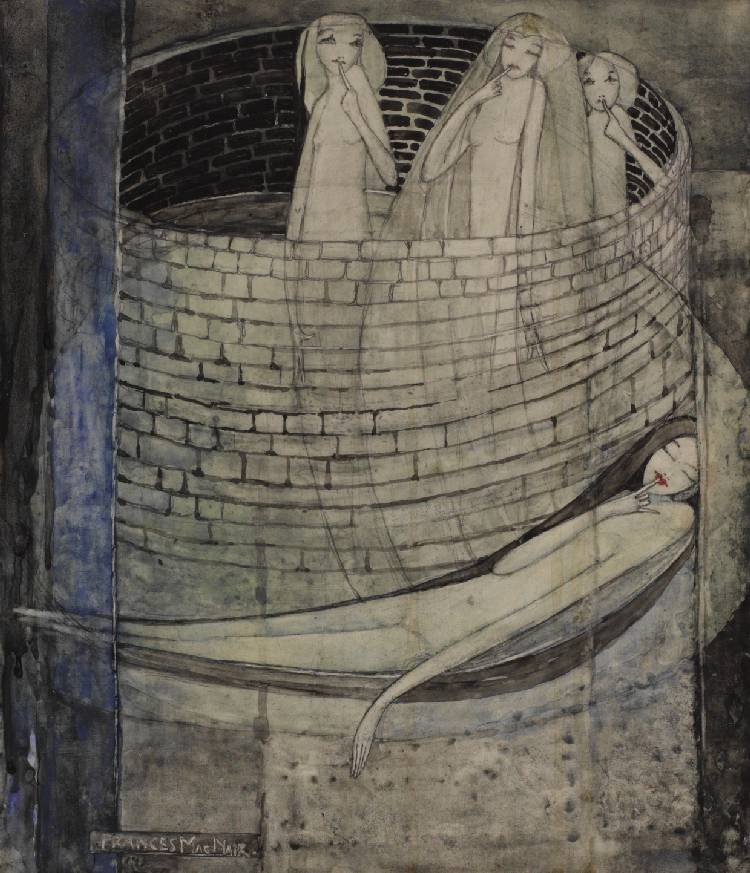
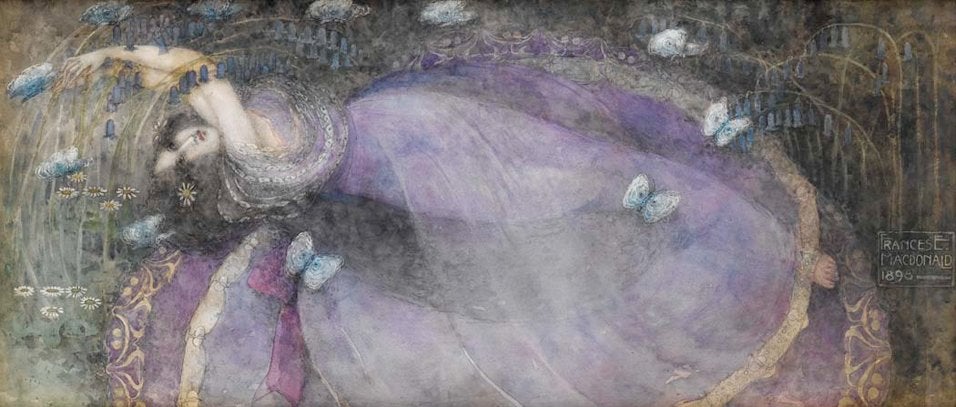
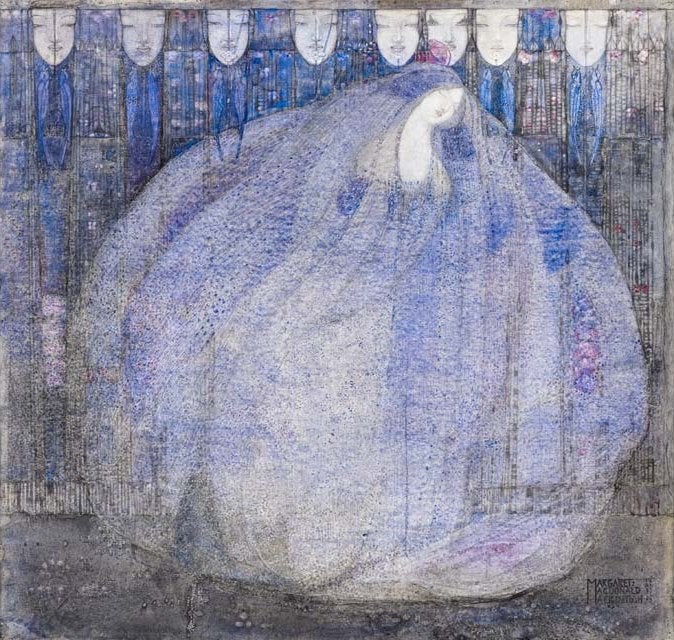

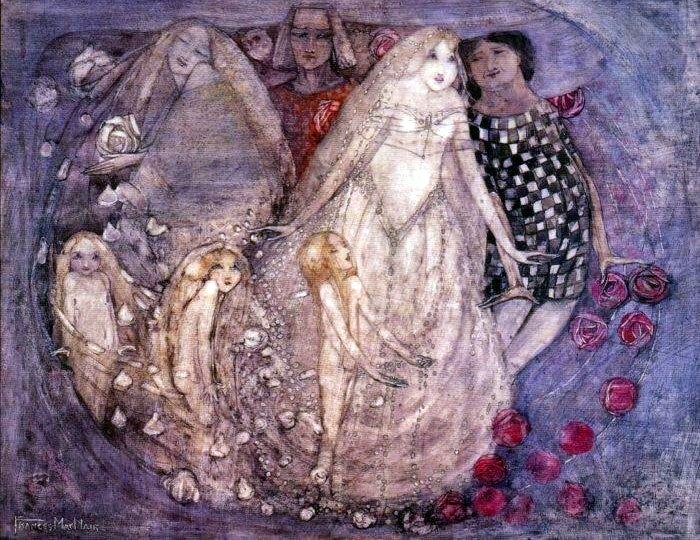
The way women are portrayed in Margaret and Frances'southward work echoes their ain independence. Whereas many women studied fine art more than for personal pleasure than profession, the sisters readily sold theirs. And upon graduation, they fix upward their own studio. Janice Helland writes that their posters, advertisements, watercolors, metalwork, and fabric designs sold well, and they exhibited across Europe for several years. Contemporaries marveled at the sisters' metalwork—a heavy, dirty process that women commonly avoided—and at their unity. They co-signed much of their early on work, and even forgot which of them had washed what. Just so they married Charles and Herbert and the dynamic changed.
Frances and Herbert moved southward to Liverpool, to a university job and family life. They filled their home with their creations, while Margaret and Charles stayed in Glasgow. Charles was becoming a famous architect and piece of furniture designer and Margaret now designed primarily for his projects. She was his muse and his colleague.
I of the well-nigh important moments for the four was the 1900 Vienna Secession. Klimt had been involved in establishing the Secession, and in 1900 they invited the Glasgow Four to showroom. Almost everything Frances and Herbert showed was something from their house, whereas Margaret and Charles brought their commercial designs.
They were a huge success in Vienna, and sold all of their piece of work. What'southward more, they were engaged to produce work in Vienna. The well-nigh important assignment was the Wärndorfer music room, installed in 1902 and 1906 (gesso panels). The furniture and interior design influenced Hoffmann and Moser's later piece of work. As for Klimt, he was entranced. It is readily said that his Beethoven Frieze in panels was influenced past the Glasgow Four, in particular Frances' piece entitled Sleep from 1899. Roger Billcliffe and Peter Vergo wrote that Mackintosh'due south utilize of squares was "imitated by the Austrians to such an extent that information technology caused the condition near of a leitmotif, peculiarly in their typographic work and volume decoration."
Weekly Newsletter
Only the heart of the Art Nouveau movement was Vienna. And when they returned to Glasgow and Liverpool, fifty-fifty though they were very busy, they were too remote to remain fundamental to the movement. Within a few years, Margaret and Charles moved south to exist nearer to London, only establishing a new clientele was difficult. Making matters worse, economic science and war took their cost. Frances and Herbert lost their coin in the 1909 financial crisis and Frances ended upwards supporting them with office-time jobs. Her disillusionment defines her subsequently work. Helland points out that pieces like Man makes the beads of life, but adult female must thread them (1912-fifteen) vacillated between refusing to please and seeking to please. And in 1921 when Frances died of a cognitive hemorrhage at the age of 48, Herbert destroyed much of her work and refused to always describe over again. More than appreciated in Germany and Austria than at abode, Charles was falsely accused of spying for Deutschland during WWI. Within two years of Frances' death, Charles and Margaret moved to France to live quietly and pigment.
Of the Glasgow Four, Charles Rennie Mackintosh is now the nearly well-known. But traces of each of the Glasgow Iv be in his work. Every October Glasgow holds a Creative Mackintosh Festival. Visitors can move around the urban center during the festival, discovering traces of the Glasgow Four. The Kelvingrove and Hunterian museums have permanent displays of the four artists, merely they are largely forgotten to the rest of the world. Is it fourth dimension, perhaps, to rediscover these two sisters whose luminescence is a function of the "signifier of modernity" that was Art Nouveau?
Join Our Newsletter
rowallanwintakephe.blogspot.com
Source: https://daily.jstor.org/the-scottish-sisters-who-pioneered-art-nouveau/
0 Response to "Truth Lies at the Bottom of a Well Francis Art Nouveau"
Post a Comment