what were the differences that divided the north and south prior to the civil war
The Civil War is oftentimes referred to as the fourth dimension of our nation's darkest days. It has been given many names, such as the State of war Between the States, the War Against Northern Aggression, the State of war of Rebellion, the Brothers' War, and others. No matter what name you employ, information technology was without a incertitude i of the nearly important events in the history of the nation. It brought slavery to an end, which in turn acquired the downfall of the Southern plantation and the aristocracy of plantation owners. It began a new political era, and marked the start of industrialization, big business organisation, and strong central government. The Civil War was also the costliest war in American history, with more than 620,000 fatalities (two percent of the population!) — more than whatsoever state of war before or since.
During the Civil War, the land was divided between the North (Wedlock States) and the Due south (Confederate States). The division began long earlier the onset of the war in 1861. It had many causes, but at that place were two primary issues that split the nation: offset was the issue of slavery, and second was the residual of power in the federal authorities.
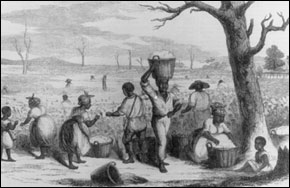 | ||
| Pre-War engraving of slaves working in a Georgia cotton field. (Courtesy Library of Congress) |
The South was primarily an agrarian society. Throughout the S were large plantations that grew cotton fiber, tobacco and other labor-intensive crops. The more than than four million slaves in the S were crucial to the plantation style of life. They provided cheap labor, which allowed the plantation owners to grow their crops more cheaply than hiring free people to piece of work the fields. Without slaves, the South believed that their region's economy would be destroyed.
The Due north, withal, consisted more often than not of big urban cities and did not accept a great demand for slave labor. They too wanted their tax dollars spent on things like new roads, canals and railroads. However, the S was more rural, and so they did not have the need for such infrastructure. This led to a disagreement with the North on how to spend the tax dollars. The North, and many people in the Southward, also felt that slavery should be abolished for moral reasons.
A Delicate Balance
The balance of power in the federal government also played an important role in dividing the nation. When the country was founded, the founding fathers wanted to brand certain that a king or dictator never ruled the states once more. Therefore, the Constitution limits the power of the federal government and allows private states to brand many decisions on their own. The founding fathers were fearful that the federal authorities would go very powerful and try to rule over the states' private rights and freedoms.
Southerners idea that the Constitution gave them the ability equally a state to declare whatsoever national federal law illegal. They thought that states' rights were greater than federal rights. Just the Northerners believed that the national authorities's ability superceded the states'. Therefore, as new states were admitted to the Union, it tipped the residual of ability.
Each country has 2 senators and if you accept an equal number of slave states and free states, then you have an equal number of senators who would vote similarly on issues. Withal, in the first half of the 1800s, the Union was growing at an enormous rate. Every bit the nation's borders pushed due west, there was much tension as to whether each new state would be slave or free.
If a new state immune slavery, then information technology was more likely to tip the rest of ability in favor of the Democrats. If it were a free state, information technology would tilt the ability in favor of the Whig Political party. Considering neither party wanted to upset the balance of power, they tried to compromise. I compromise was the Missouri Compromise.
In 1820, Missouri sought admission to the Matrimony as a slave-belongings country. But this would tip the power in the Senate, so afterward two years of debating, they finally agreed that Missouri could enter equally a slave country every bit long equally Maine was allowed to enter into the Matrimony as a gratuitous state. The compromise also prohibited slavery n of the latitude 36° 30' in the Louisiana Purchase — with the exception of Missouri.
The compromise worked for a while, but then in that location were disagreements over country caused from United mexican states after the Mexican-American War. The Compromise of 1850 admitted California as a free state, and gave the territories of New Mexico, Nevada, Arizona, and Utah the ability to decide for themselves if they were going to be complimentary or slave states.
A third comprise was tried in 1854. It was the Kansas-Nebraska Act, and information technology immune settlers in those states to determine for themselves whether they would allow slavery or not when they applied for statehood. Notwithstanding, the human action split the Autonomous Party and destroyed the Whig Party, members of which would join with the antislavery Democrats to form the Republican Political party.
President Lincoln won the presidency as the starting time Republican president in Nov 1860. He won with only 40 percent of the vote and was not fifty-fifty on the ballot in 10 southern states. His ballot was the last straw for the Due south. They were afraid that President Lincoln would try to abolish slavery in all states, and on Nov. six, 1860, the slave states met to consider seceding from the Wedlock.
Southward Carolina was the start state to secede on Dec. 20, 1860. Over the adjacent month, Mississippi, Florida, Alabama, Georgia, Louisiana, and Texas all followed in secession to grade the Confederate States of America. On February. 8, 1861, these states adopted the Constitution of the Amalgamated States of America. It was similar to the U.S. Constitution, but it strengthened the rights of the slaveholders.
On April 12 at 4:thirty a.m., the Civil War began when Confederate forces attacked a U.Southward. military installation at Fort Sumter in South Carolina. President Lincoln saw this as an act of treason. He called for 75,000 troops, which alarmed the other slave sates of Virginia, Arkansas, Tennessee, and North Carolina. The four states so seceded from the Spousal relationship and joined the Confederacy. There was no turning back now, and no compromise would save the Union this time.
rowallanwintakephe.blogspot.com
Source: https://monitor.noaa.gov/150th/division.html
0 Response to "what were the differences that divided the north and south prior to the civil war"
Post a Comment