What did the USSR hope to get in eastern Europe after WWII?
How Communism Took Over Eastern Europe Afterward Earth War II
An interview with Anne Applebaum almost her new book, The Crushing of Eastern Europe
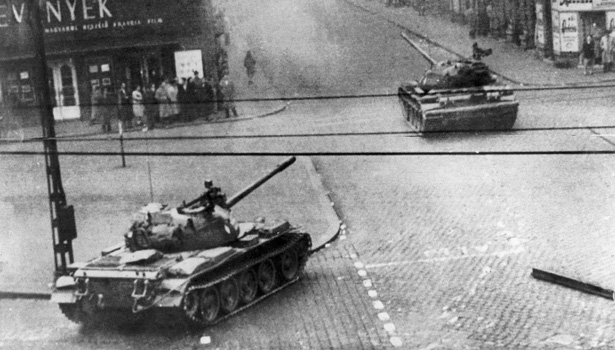
Soviet-built tanks cycle into activity in a smoke-filled Budapest street during Hungary's rebellion against communist satellite government in October of 1956. (AP)
In a long-awaited history due to be published this calendar week, journalist and author Anne Applebaum draws on immediate accounts and previously unpublished archival cloth to depict how the Kremlin established its hegemony over Eastern Europe at the terminate of World War II. The book, titled Iron Pall: The Crushing of Eastern Europe, 1944-56, explores the gutting of local institutions and the murders, terror campaigns, and tactical maneuvering that allowed Moscow to establish a system of command that would concluding for decades to come up. I spoke with, Applebaum, whose previous book, a history of the Soviet Gulag, won the Pulitzer Prize.
Your volume concentrates on three countries -- Eastward Deutschland, Hungary, and Poland. What made you choose them in item?I chose those three precisely considering they are and then dissimilar and they simply had extremely unlike experiences of state of war. Germany obviously was Nazi Germany, Hungary had been a state somewhat in-betwixt, a sometimes happy, sometimes unhappy ally of Hitler, and of course Poland was an marry and very actively [involved in the fight confronting Hitler.]
And so therefore there were iii countries with different contempo histories and what interested me was the fact that despite those cultural differences, despite the linguistic differences, despite the contempo political history, by about the year 1950 if you'd looked in at this region from the outside, they would have all appeared very similar.
In the preface, you land that one of the purposes of the book it is to study the history of totalitarian countries and the methods employed past dictators to suppress populations. What tin can be learned from the history of the Soviet influence in Eastern Europe?What you learn from studying the menses is several things. One is how well prepared Stalin was earlier he got there. He had for example prepared police forces, secret police force forces for each of the countries before he arrived in those countries. Most notably in Poland he begins recruiting policemen from the twelvemonth 1939. Of course nosotros've always known that he prepared and recruited, and organized communist parties from the fourth dimension of the Bolshevik Revolution onwards.
You besides see which kind of institutions the Soviet Union was virtually interested in. For example, everywhere that the Red Regular army went, i of the first things they did was accept over the radio station. They believed very much in propaganda, in the power of propaganda and they believed that if they simply could accomplish the masses by what was and so the nearly efficient ways possible, namely the radio, and so they would be able to convince them and so they would exist able to accept and hold power.
You too learn about some of their obsessions, some of the things they were concerned about. From the earliest days of the Soviet Union, Soviet representatives in the region were very interested in what we at present call civil society. So they were very interested in self-organized groups. That means both political parties, it ways soccer clubs, it ways chess clubs. Self-organized groups of all kinds were a target of Soviet interest and in some cases repressed from the very beginning.
Despite the Soviet Spousal relationship'due south elaborate preparations to expand its influence in Eastern Europe, y'all write that in that location was a great diverseness of political parties, private ownership, and free media left to thrive at the offset. Then was the Soviet Union's initial occupation plan far from ideal?They didn't plan perfectly. They planned strategically. And they didn't know how long information technology would have to occupy these countries or to change their political systems, and in fact we have some bear witness that they thought it might take a very long fourth dimension -- 20 years or 30 years before Europe is communist.
They likewise thought from the start that it was only a matter of time before they and their ideas were popular. So one of the reasons they held elections -- and at that place were some gratis elections in the region, particularly in Hungary and in Due east Germany, also in Czechoslovakia very early on -- is because they thought they would win. They idea, y'all know, Marx told us that outset there volition be a bourgeois revolution, then there will exist a communist revolution, and sooner or later the workers will have the consciousness, they volition come to consciousness themselves as the moving forces of history and they volition empathize that communism is the way to become and they'll vote us into ability.
And they indeed were very stunned in some cases when it didn't happen. I mean, one of the reasons for the big reversal when they cut off this early evidence of commonwealth was that they were losing. They lost those early elections and they realized they were going to lose them fifty-fifty more in the next round and they decided to terminate holding them. According to your book, Stalin was pursuing more than ideology in Eastern Europe. He besides had a geopolitical and even a mercantile agenda.
There is one statement I don't really become into in my volume that 1 of the reasons for the postwar success of the Soviet Union was that it occupied and took over the industrial production of these countries. Information technology itself was very weak later the state of war and at that place were even famines in the Soviet Marriage after the war, every bit we know.
Did Stalin intend to create some sort of a buffer zone betwixt the U.S.S.R. and the Westward past occupying Eastern Europe out of fear that the West might eventually assault the Soviet Union?The Soviet Marriage actually didn't recall like that. The people who occupied Eastern Europe and the people who collaborated with the Soviet Wedlock weren't thinking in those terms. The generals and the NKVD officers who came into the region were thinking they were pushing the boundaries of the socialist revolution and that it was merely a matter of fourth dimension before they moved from Eastern Europe to Western Europe. You lot write that the Soviet Union started ethnic cleansing in Eastern Europe soon after its occupation. Who was the primary victim and what were the motives backside the picking of particular ethnic groups for cleansing?
The process of ethnic cleansing was much more elaborate than nosotros often now recall. Many millions of people had to be put on trains and shipped out of the country and I should stress two things about it: 1 is that the communist parties themselves in many of these countries ran this process and the 2d is that it was extremely pop. The deportation of the Germans was considered a great achievement of the communist parties and was thought as such at the time, even though it was of course brutal and cruel and in many cases unfair. Germans who had worked on behalf of the Polish resistance were deported alongside Germans who had been Nazis.
The other great deportation -- 1 of the other great deportations of the region -- was essentially the swap of Poles and Ukrainians. When the Polish border was moved W, that left quite a number of Poles in the Soviet Union, it also left a number of Ukrainians in what had been Poland and at that place was a conclusion to swap them, to send one for the other. And this was also not an easy process, because many of those people had lived in their villages for centuries and they were uninclined to go. And and then at sure points force was used, threats were used, at one point there was in effect an open up war between Poles and Ukrainians in those eastern regions, something that's not known very well in the residual of the world.
Despite the repressions, the Soviet Marriage plant allies in Eastern Europe who were eager to interact and actively took role in the violence themselves. Who were these people? Did they harbor political convictions or were they simple opportunists who just strove to gain ability through cooperation with Moscow?I remember they were people who were both. They were both opportunists and they were people who had convictions. I mean, think that because people had convictions .... Having convictions doesn't make you a moral person or a practiced person, I mean, the Nazis also had convictions, they were convinced that their organization was correct. Then in that location were many people who were convinced that this manner of thinking was right and had been scientifically proven by Marx. And then many of them were ideologues and at the aforementioned time they were opportunists, they saw that if they hewed to the party line and if they remained close to Moscow they would remain in power.
This mail service appears courtesy of Radio Costless Europe/Radio Liberty.
rowallanwintakephe.blogspot.com
Source: https://www.theatlantic.com/international/archive/2012/10/how-communism-took-over-eastern-europe-after-world-war-ii/263938/
0 Response to "What did the USSR hope to get in eastern Europe after WWII?"
Post a Comment