Find these visible planets from mid-March 2022 to early April: Venus blazing in the east before sunrise; Mars and Saturn, likewise in the east before sunrise; Jupiter, emerging in the east before sunrise by late March or early April. Mercury will render to the evening sky past mid-Apr, for its all-time evening apparition for the Northern Hemisphere. Visible planets in depth below.
In this article:
Dark sky guide March-Apr 2022
Mid-March to early April 2022 visible planets in depth
March-Apr 2022 heliocentric solar system
Some resources to enjoy
Nighttime sky guide March-April 2022
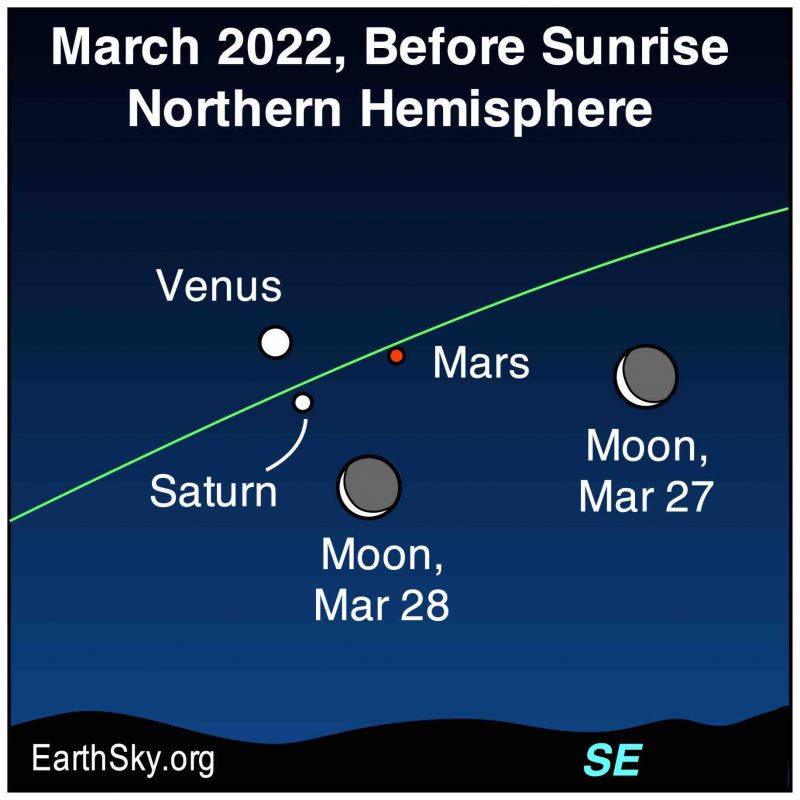
Mornings of March 27 and 28 for Northern Hemisphere
With all the planets clustered in the eastern predawn heaven, it'southward only logical that the waning crescent moon should sweep past them. And and then it does, around March 27 and 28. Every bit seen from the North America and Europe on March 28, the crescent moon, Venus, Mars, and Saturn all agglomeration together inside an 8-caste circle. Beautiful!
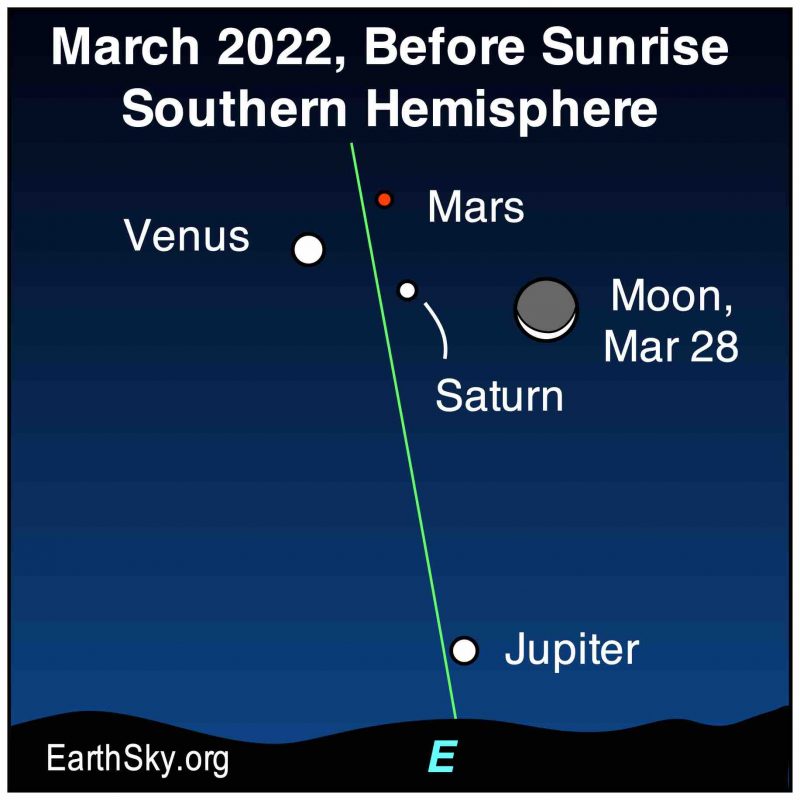
Mornings of March 28 for Southern Hemisphere
This chart is the Southern Hemisphere counterpart of the chart above. Notice the green line on this nautical chart – the ecliptic – in contrast to the chart to a higher place. It'southward fall now in the Southern Hemisphere. And the angle of the ecliptic is e'er steep on autumn mornings. Meanwhile, in the chart above, you tin see that the spring bending of the ecliptic – for us in the Northern Hemisphere – is narrow. Chart by John Jardine Goss.
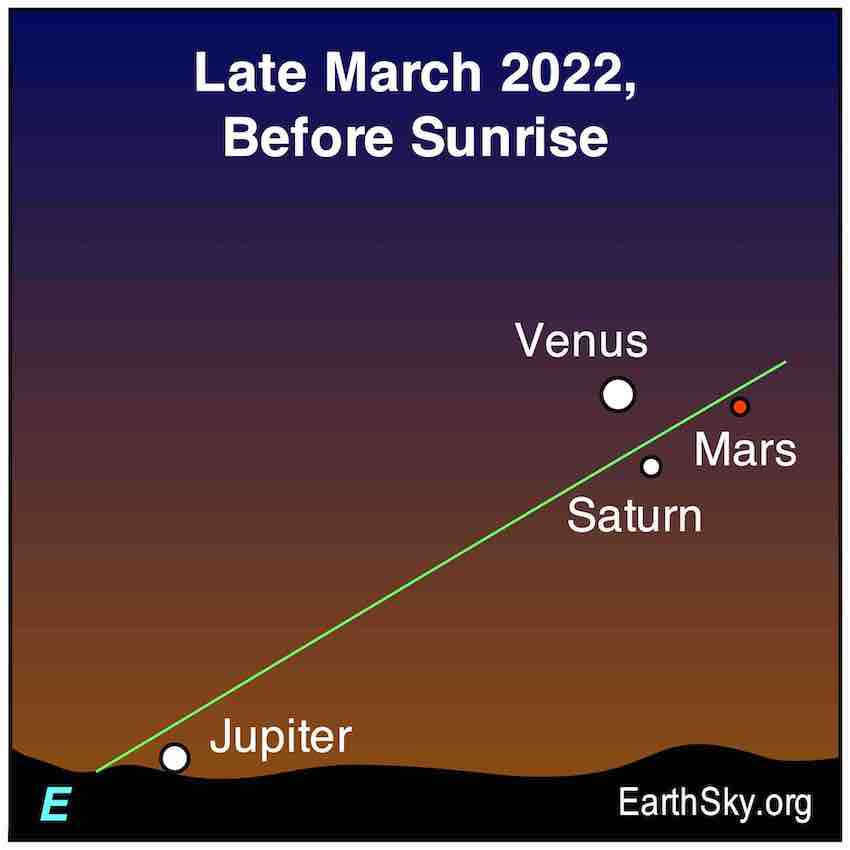
By tardily March (perchance): Jupiter emerging from dawn
Bright Jupiter might poke above your eastern horizon shortly before sunrise past late March. Will you see information technology, below the other planets? Peradventure … if your skies are clear and you take an unobstructed horizon. Jupiter will return in earnest in April!
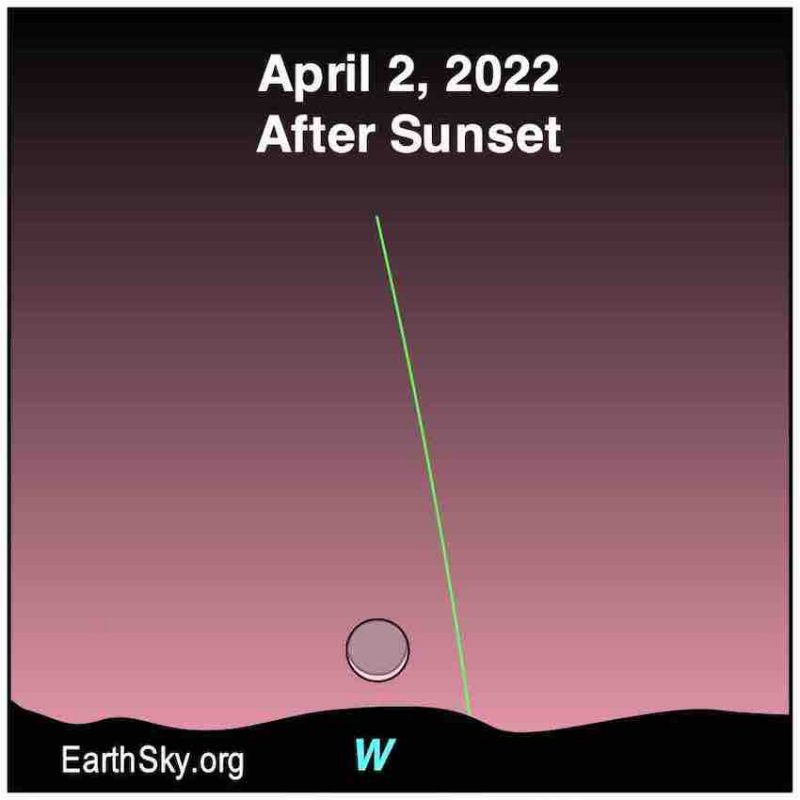
Evening of April ii: A very young moon
New moon happens at 6:24 UTC on Apr 1, 2022. And evenings in bound are the all-time time to see very young moons – very thin crescents – almost the horizon after sunset. Will anyone see the moon after sunset on Apr 1? Possibly. The farthest west you lot are, the more than likely you'll run across a young moon on April 1. Simply – given clear skies – all of us in the Northern Hemisphere should see the very thin crescent moon, floating just above the western horizon later sunset. An exquisite sight! Chart via John Jardine Goss.
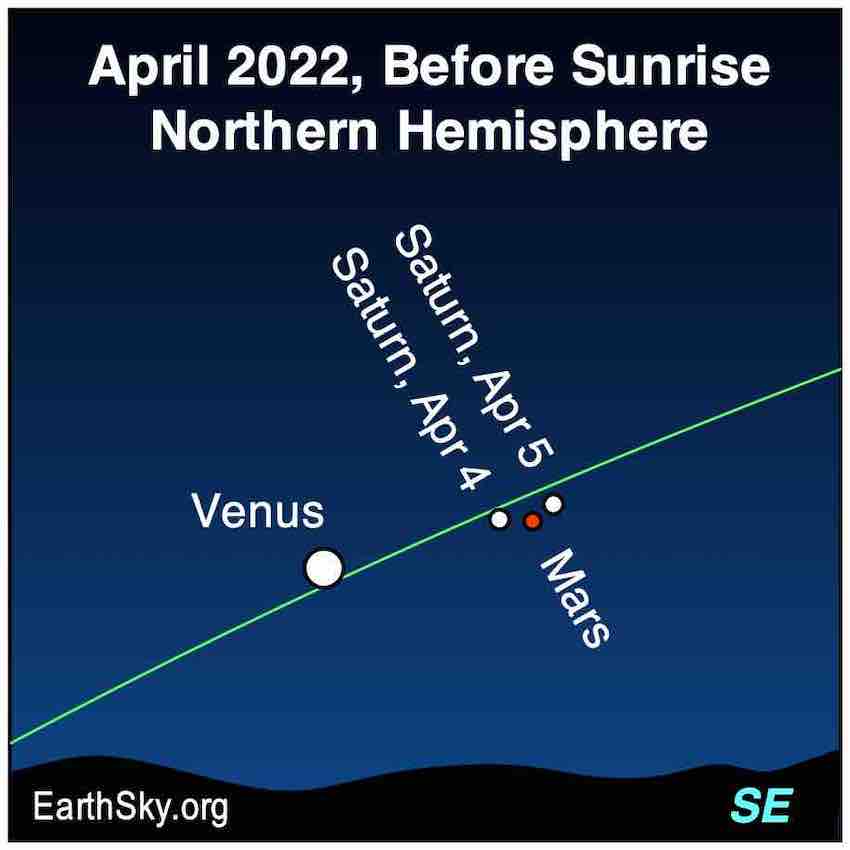
Mornings of April 4 and 5: Mars and Saturn conjunction
On April four and five, 2022, look depression in the sunrise direction, maybe an 60 minutes before sunrise. Ruddy Mars and golden Saturn will expect like next-door neighbors on the sky's dome. Note the difference in Saturn's position with respect to Mars from April four to Apr v. Their conjunction – when the two planets volition take the same right ascension on our heaven'due south dome – will come at 22 UTC on April 4. At that time, Mars will be 0.3 degrees S. of Saturn. Analogy via John Jardine Goss.
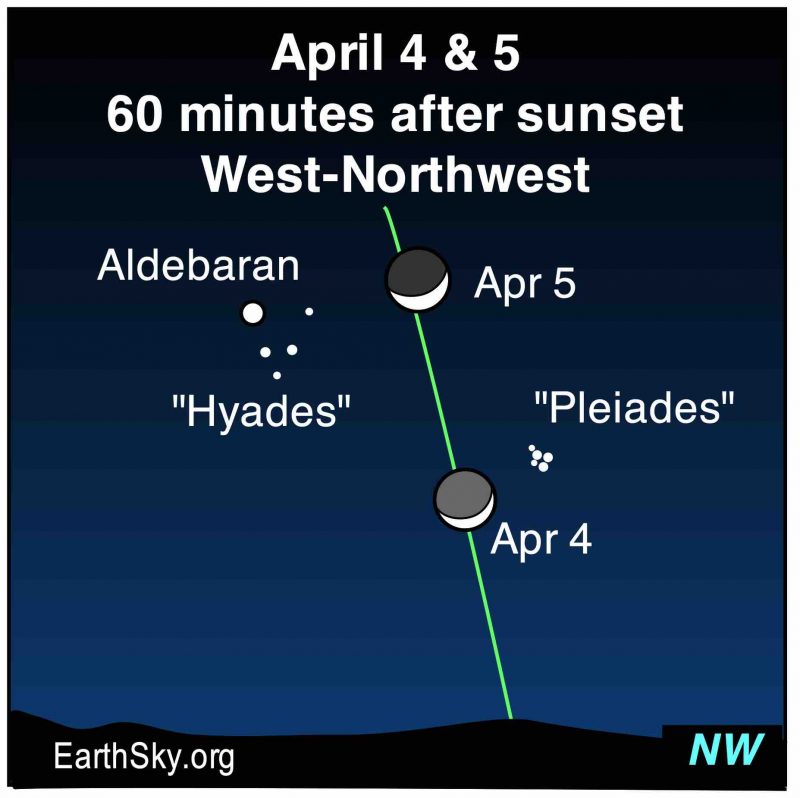
Evenings of April four and 5: Crescent moon past famous star clusters
On April 4 and v, 2022 – in the evening sky – the crescent moon visits 2 famous star clusters located in the management of the constellation Taurus the Balderdash. The Hyades cluster is shaped like the letter 5. Aldebaran, brightest star in the V, is not a true cluster member. The Pleiades star cluster – aka the Vii Sisters – is shaped like a tiny misty dipper of stars. Look west after sunset for the moon and these beautiful clusters, which are about to leave the evening sky. Analogy via John Jardine Goss.
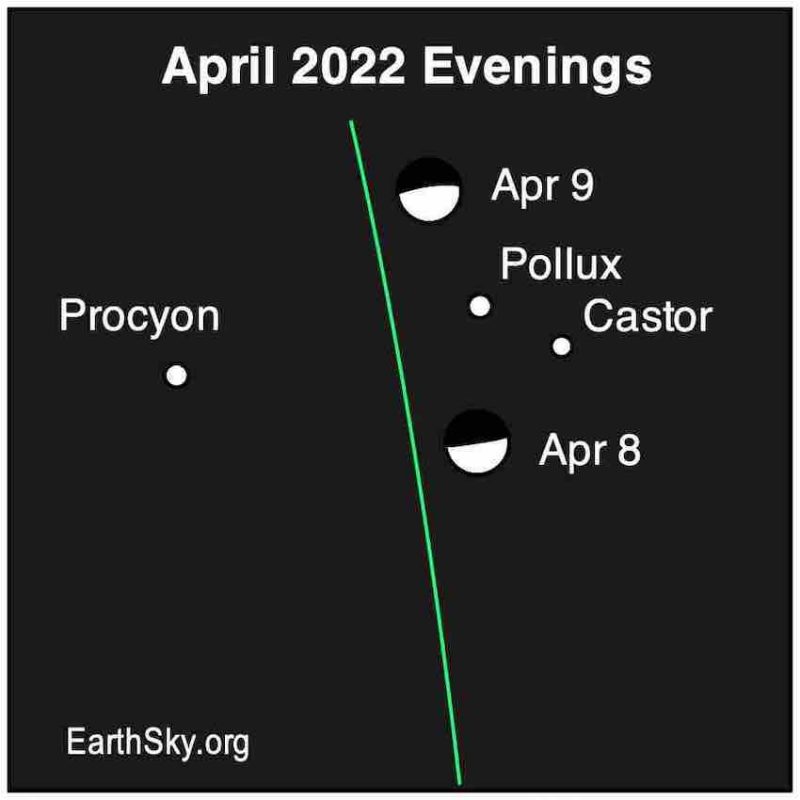
April 8 and ix evenings: Castor and Pollux by the moon
The moon passes the brilliant stars Castor and Pollux in Gemini the Twins on April viii and ix. The moon reaches its 1st-quarter phase on April 9. Nautical chart via John Jardine Goss.
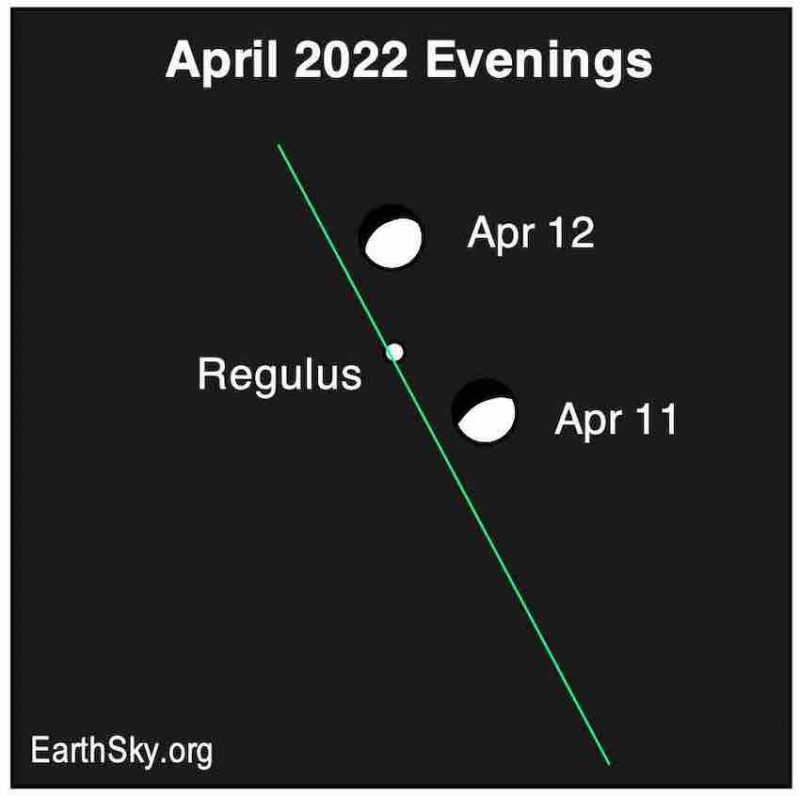
Apr 11 and 12 evenings: Regulus and the moon
On Apr 11 and 12, a waxing gibbous moon passes close to the brightest star in Leo the Lion: Regulus. Nautical chart via John Jardine Goss.
By mid-April: iv planets from the Northern Hemisphere
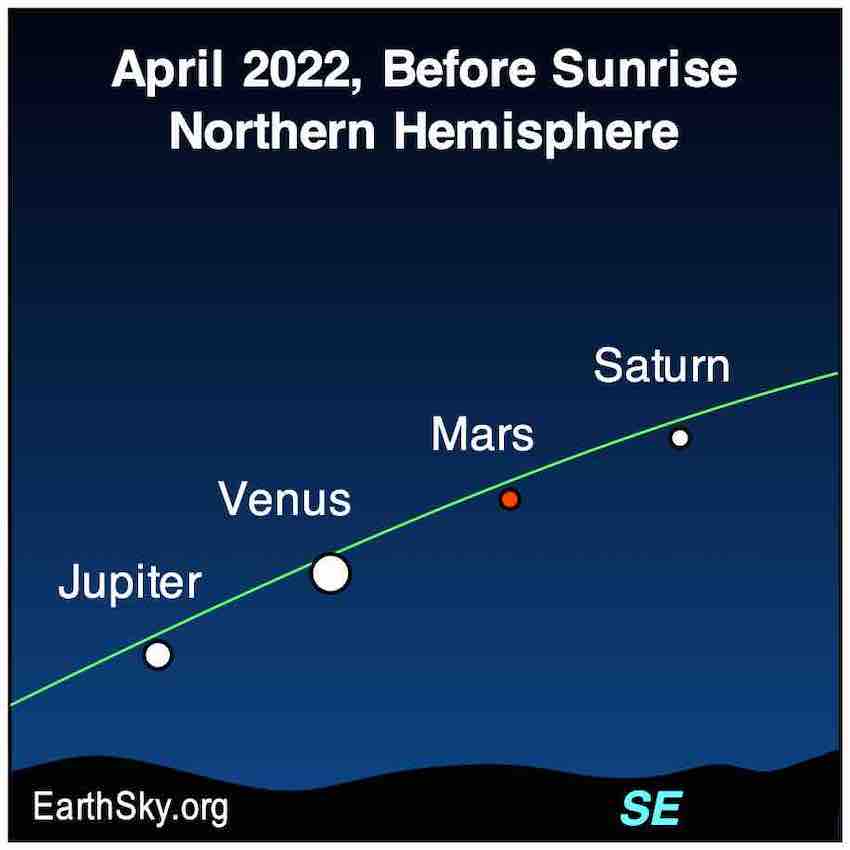
Some of you might have glimpsed Jupiter near the sunrise every bit early as late March, 2022. By mid-Apr, we'll all see Jupiter in the sunrise direction, about an hour earlier the sun comes upward. You'll recognize information technology easily every bit the 2nd-brightest planet, afterwards Venus. Here is the placement of the 4 bright planets in the morning heaven around mid-April, as viewed from the Northern Hemisphere. The same 4 planets are visible from the Southern Hemisphere, too. See the nautical chart below.
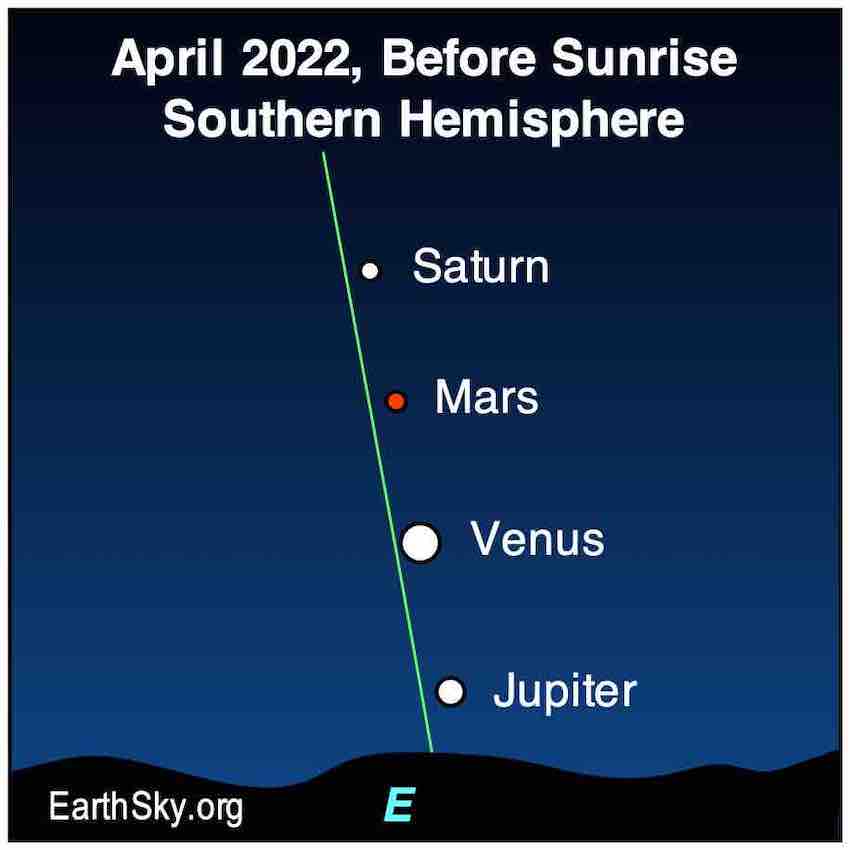
By mid-April: 4 planets from the Southern Hemisphere
Note the contrast between this chart and the one in a higher place. The same 4 planets – Jupiter, Mars, Saturn and Venus – tin can exist seen before sunrise, with Jupiter closest to the sunrise point. Only it's autumn now in the Southern Hemisphere. So the ecliptic, or sun's path, makes a steep angle to the morning horizon, placing the planets high in a higher place the sunrise.
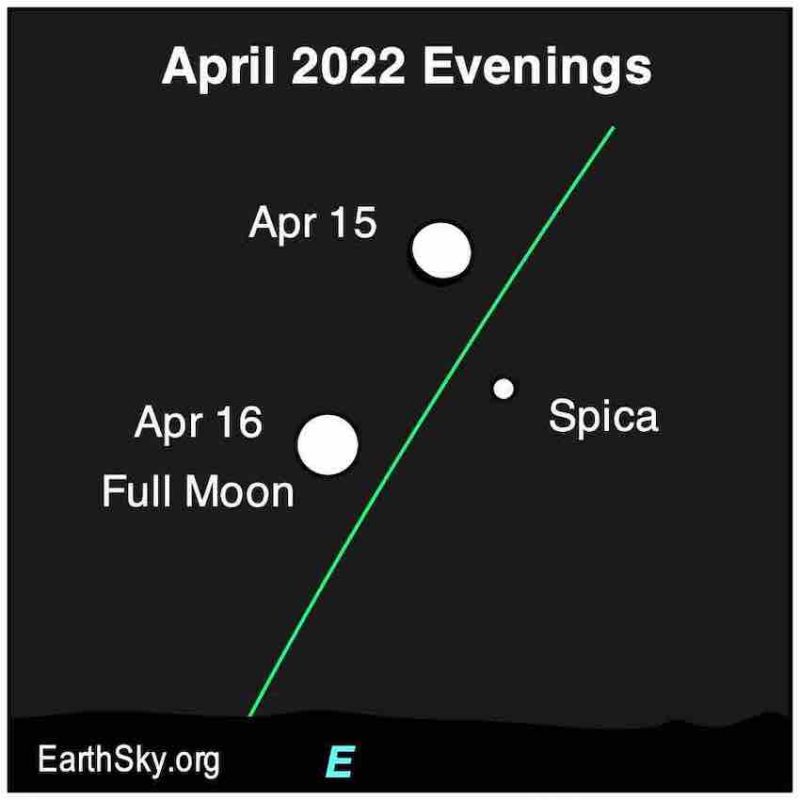
Apr 15 and 16 evenings: Moon and Spica
If yous're enjoying the full or most full moon on Apr 15 and 16, you lot'll probably discover a bright star nearby. That star is Spica, the brightest star in the constellation Virgo. Chart via John Jardine Goss.
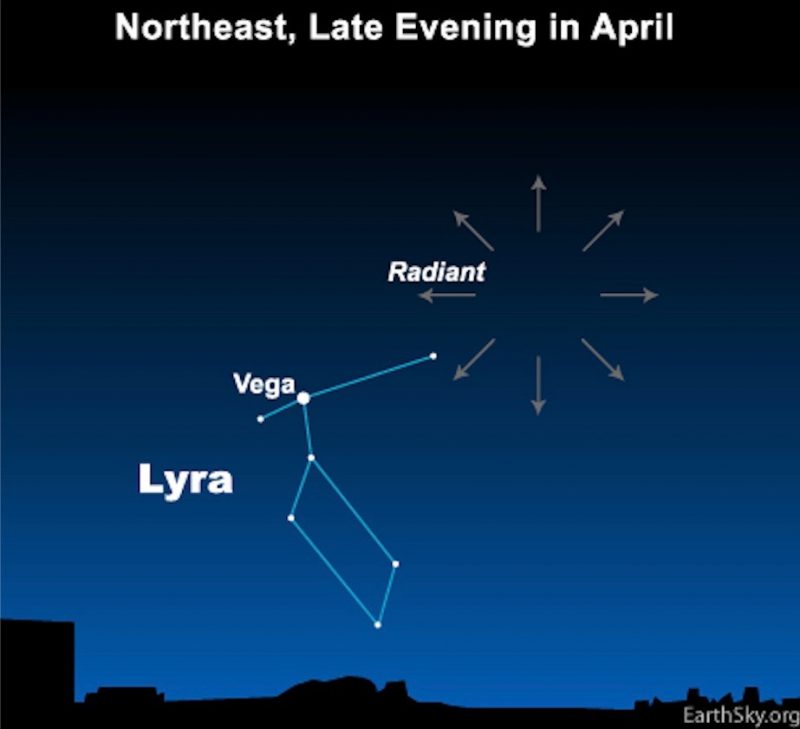
April 15 to 29, peaking on 22nd: Lyrid meteor shower
Lyrid meteors radiate from near the bright star Vega in the constellation Lyra the Harp. You lot don't demand to place Vega or Lyra in order to picket the Lyrid shooting star shower. But you practise need to know when the radiant rises, in this example in the northeast earlier midnight. That's why the Lyrids are typically best between midnight and dawn, and why the last quarter moon will interfere with the shower in 2022. Yous'll see the almost meteors after the radiant has come over the horizon. The meteors radiate from there just will appear unexpectedly in any and all parts of the heaven. Read more than about April's Lyrid falling star shower.
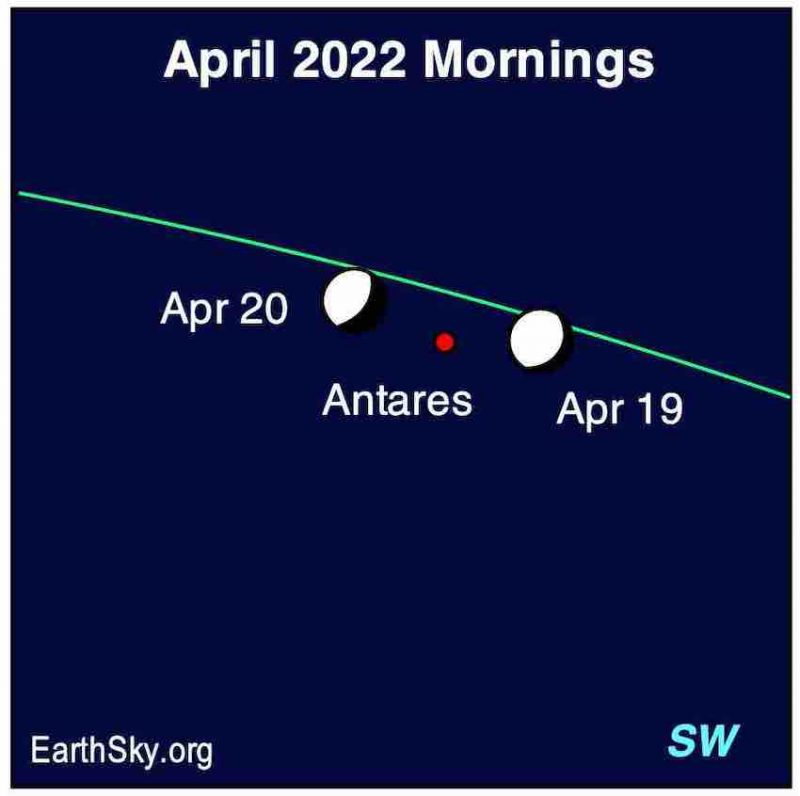
April 19 and xx mornings: Moon and Antares
For those upwards early April 19 and xx, you may exist asking, "What'due south that bright star by the moon?" That reddish star is Antares in the constellation Scorpius. A waning gibbous moon is westward of Antares on Apr 19 and due east of the crimson star on April 20. Its phase will shrink a fleck from one night to the next. Nautical chart via John Jardine Goss.
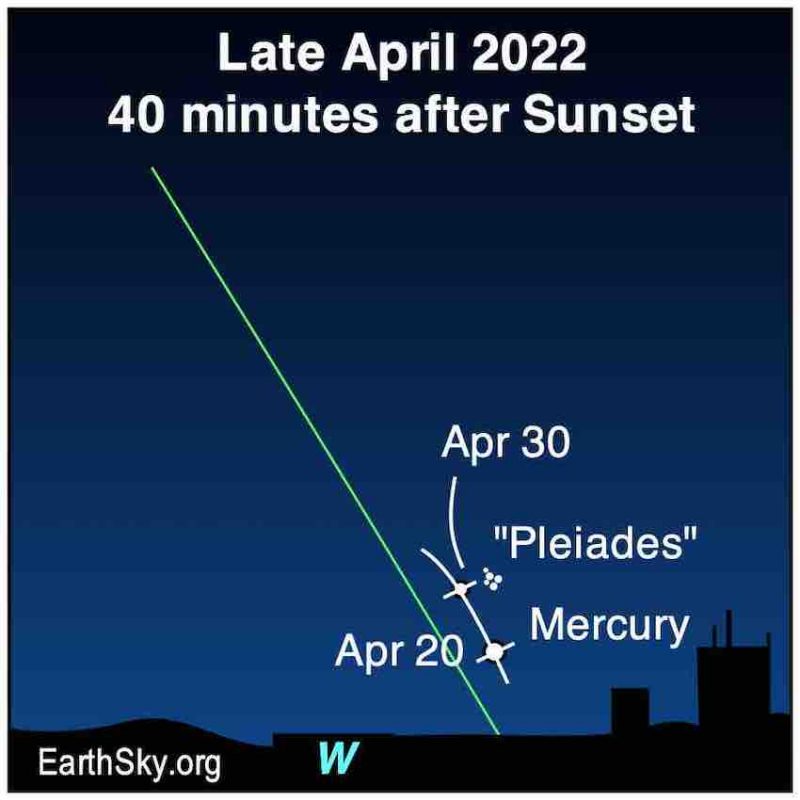
Beginning around April 20: Mercury nears the Pleiades
Watch Mercury starting around April 20, when it'south low in the west subsequently sunset. Y'all'll see the closest planet to the sun steadily climb closer to the Pleiades star cluster every night until April 30, when Mercury and the Pleiades are correct adjacent to each other. In our nautical chart, Mercury follows the white line up and gets dimmer as it nears the Pleiades, which is represented by the shrinking circle. Chart via John Jardine Goss.
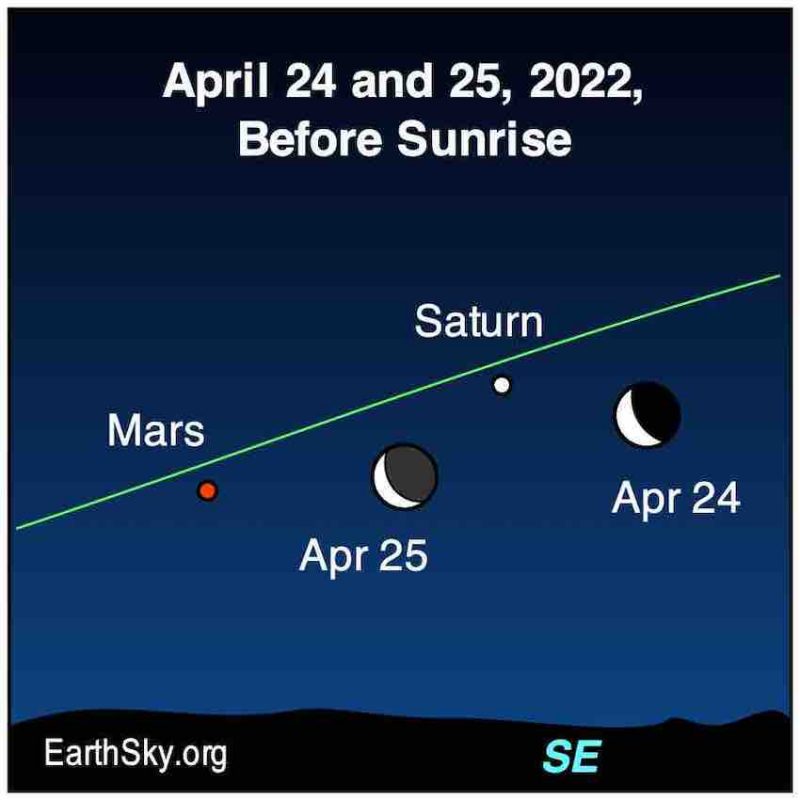
April 24 and 25 mornings: Crescent moon near Saturn and Mars
The waning crescent moon lies west of Saturn on the morning of Apr 24 and east of Saturn on Apr 25. On that morning, it appears betwixt Mars and Saturn. Chart via John Jardine Goss.
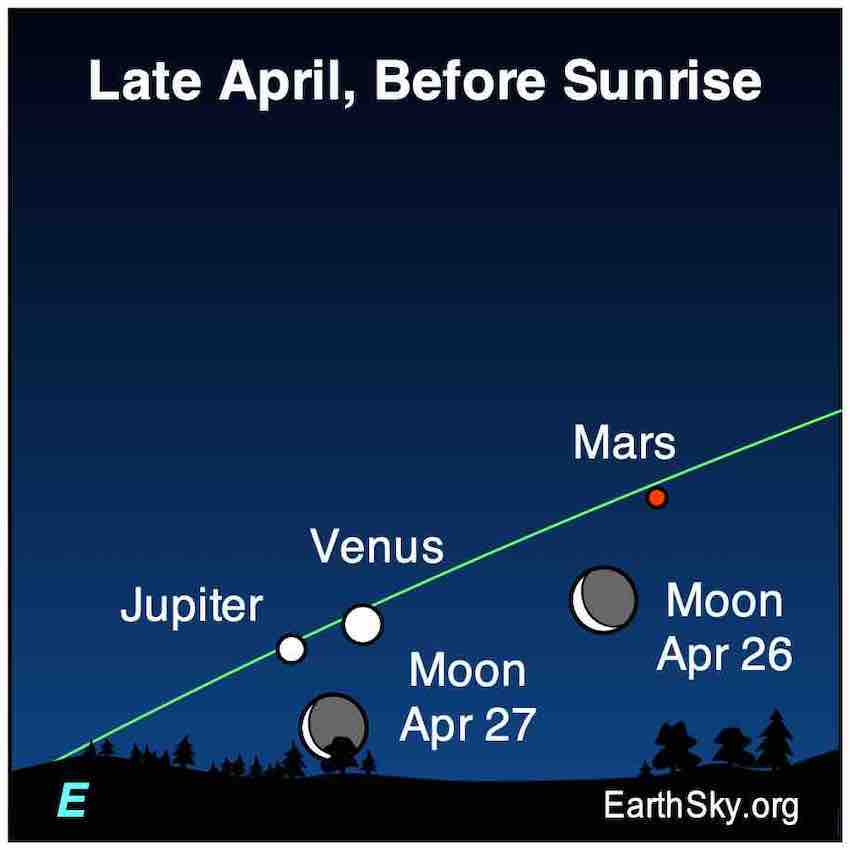
Apr 26 and 27 mornings: Crescent moon near 3 planets
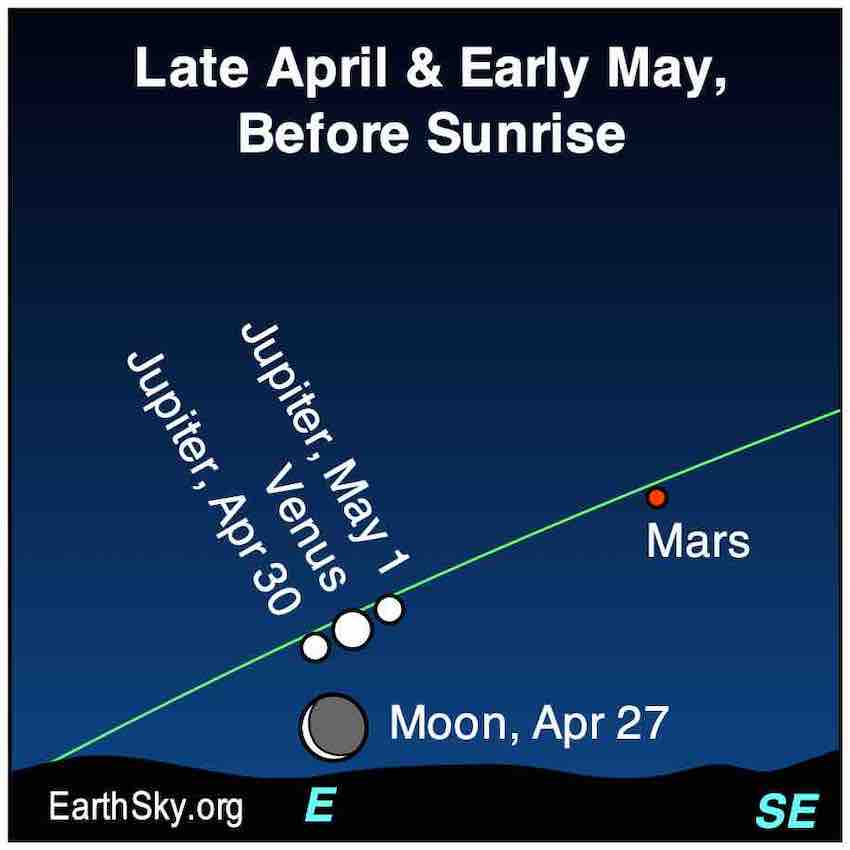
The sparse waning crescent moon first passes Mars on the morning of April 26, then hovers below Jupiter and Venus on the morning of April 27. Chart via John Jardine Goss.
In late Apr: Don't miss the Jupiter-Venus conjunction
Catch the 2 brightest planets – Venus and Jupiter – close together around the finish of April and first of May, 2022. The moon volition bring together the scene on April 27. This chart also shows that Jupiter will be on one side of Venus on Apr 30 and the opposite side on May one. That'southward because the 2 planets' conjunction – when they pass one another in correct ascension – comes at 19 UTC on April 30. At that time, Venus volition be 0.ii degrees S. of Jupiter. Too, reddish Mars on the far correct. Right at present, considering it's all the same far ahead of united states in orbit, Mars tin can't compete in brightness with Venus and Jupiter! Illustration via John Jardine Goss.
On Apr 30: A deep partial solar eclipse
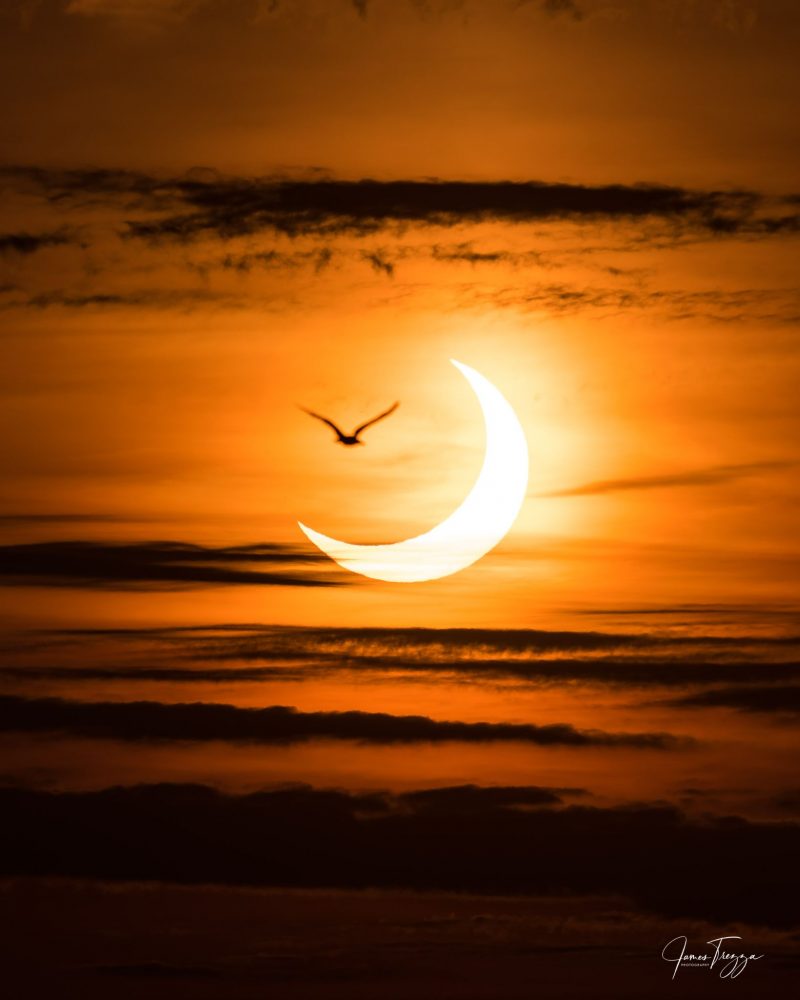
View at EarthSky Community Photos. | The April xxx, 2022, eclipse will be a partial, just deep, eclipse, non unlike to the eclipse shown in this photo. It's visible from the southeast Pacific, and south Southward America. Our friend James Trezza in Cedar Beach, Mountain Sinai, New York, captured this photograph of the partial solar eclipse on June 10, 2021. He wrote: "Solar eclipse 2021! Nothing like perfect timing with a bird flying through the frame during the eclipse." Cheers, James, and yes! Read more most the April 30, 2022 solar eclipse.
On the night of May 15-sixteen: A total eclipse of the moon
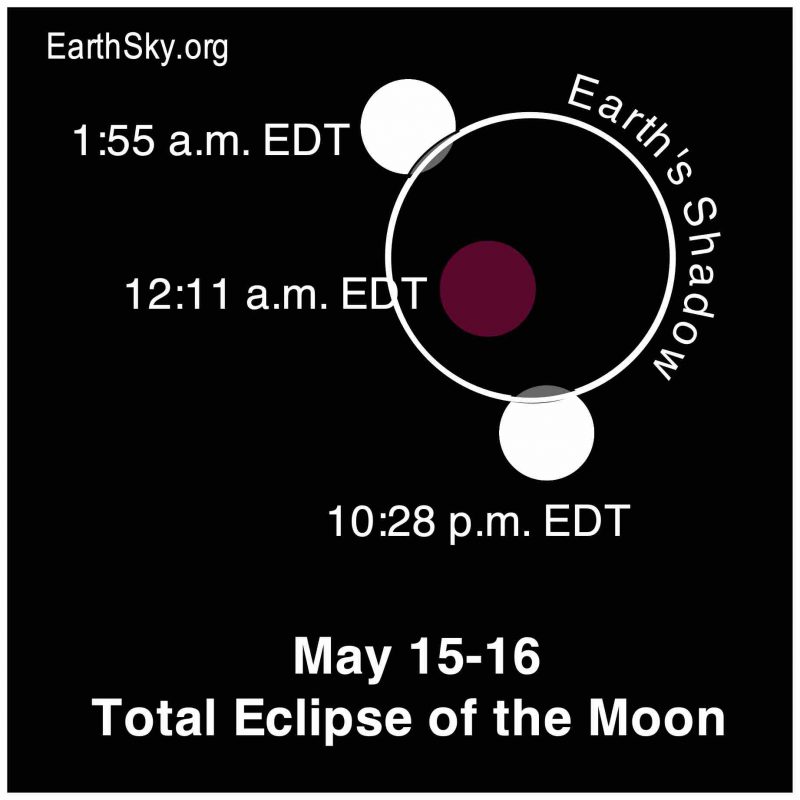
A total lunar eclipse sweeps across the Americas, Europe, and Africa during the night of May 15-xvi, 2022. The moon will enter Globe's shadow at ten:28 p.m. EDT on May 15, becoming completely eclipsed about 1 hour later. This total eclipse is central, significant the moon's disk actually passes through the axis of Earth'due south umbral shadow. Because they are so deep, such eclipses typically have the longest total phases. In this case, the duration of totality lasts almost an hr and a half: 84.ix minutes! Chart by John Jardine Goss. Read more than about the May 15-fifteen full lunar eclipse.
Mid-March to early Apr 2022 visible planets in depth
Mercury
Southern Hemisphere skywatchers had a cracking apparition of Mercury before sunrise in early on March 2022. Only, past virtually mid-month, Mercury lies too close to the eastern horizon to exist hands seen from whatsoever office of Earth. Mercury – the innermost planet – is now fleeing alee of u.s.a. in its smaller, faster orbit around the sun. Information technology'll reach superior conjunction – that is, be most directly behind the sun from Earth – on April 2. It'll then re-sally into the western sky after sunset, giving the Northern Hemisphere its best Mercury bogeyman of this yr.
Venus
Bright Venus is easy to spot in the sunrise direction – before sunrise – because it's the brightest object in the heaven, except for the passing moon. Since it passed between united states and the dominicus in January, Venus has been swinging away from the sun on our heaven's dome. And and then it'due south been actualization college in the sky earlier sunrise each twenty-four hour period. On March 20, Venus reaches its uttermost angular distance (greatest elongation) from the sun. After, over the next seven months, information technology volition slowly move a petty closer to the horizon each morning.
Mars
You'll find Mars in the same part of the sky as Venus. But, considering it's not near as bright as Venus, Mars can be overlooked. It started the calendar month 5 degrees (or 1 binocular field) below Venus. As March mornings have continued, it has moved west of Venus, always remaining 1 binocular field away from the brilliant planet. Notice Mars' color. Information technology'southward chosen the Red Planet for a reason.
Mars is now first a new cycle of visibility in our sky. Throughout 2022, it'll brighten and shift into our evening heaven, equally Earth draws up backside Mars in our smaller, faster orbit around the sunday. Earth and Mars will be closest on December 1. Our two worlds will be most nearly on a line in space – bringing Mars to its once-in-ii-years opposition – on the night of December vii-8.
Saturn
At the start of March, Saturn lay too low above the sunrise horizon to be seen by Northern Hemisphere skywatchers (although Southern Hemisphere observers might have glimpsed information technology). After mid-March, though, the ringed planet tin be constitute shining dimly, close to the sunrise, near the horizon equally the dawn light is rise. As the mornings laissez passer in March, Saturn moves toward Venus and Mars in the sky. On March 24 it forms an interesting flat isosceles triangle with those other two planets. Four mornings later, on March 28, the sparse crescent moon joins to the scene. By the last morning of March, Saturn will take moved so that it lies in between Venus and Mars.
Saturn is also just starting time its cycle of visibility in Earth's sky. It'll come to opposition – rising at sunset, highest at midnight, setting at sunrise – on Baronial 14.
Jupiter
Jupiter hides in the solar glow for most of March 2022. The mighty planet reaches its superior conjunction (when it's nearly directly behind the sun as seen from Earth) on March 5. As March ends, Jupiter is merely outset to emerge from the morning twilight. Southern Hemisphere observers will encounter it best in late March. Just you might glimpse information technology from the Northern Hemisphere, too, especially if you're at a southerly latitude in this hemisphere (say, the southern U.S. or similar latitudes). Remember, Jupiter will exist very brilliant! It's 2d only to Venus. So gear up to spot Jupiter on a belatedly March or early on April morning, when y'all'll find it beaming out, perhaps surprisingly, from the eastern dawn glow.
Much like Saturn, Jupiter volition spend 2022 shifting from the morning to the evening sky. Information technology opposition volition come up on September 26.
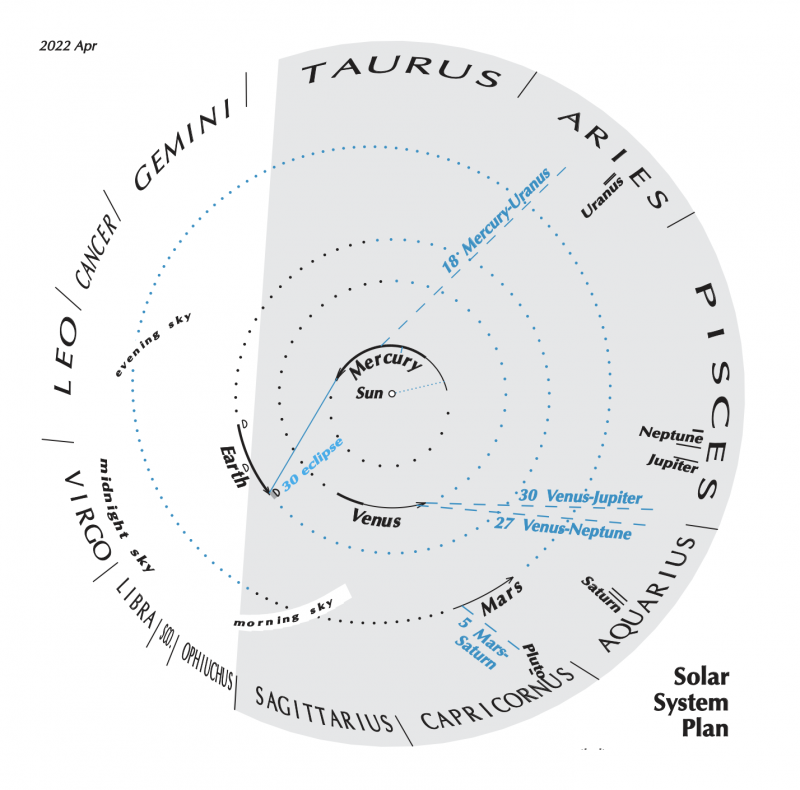
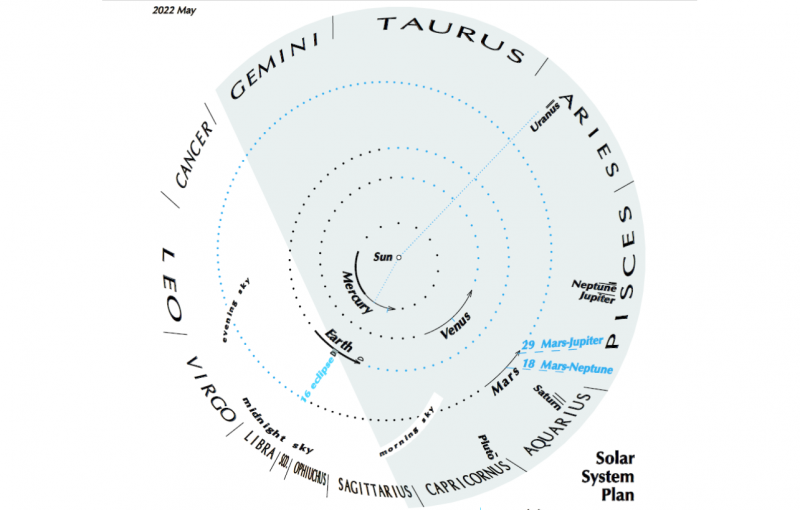
March-May 2022 heliocentric solar system
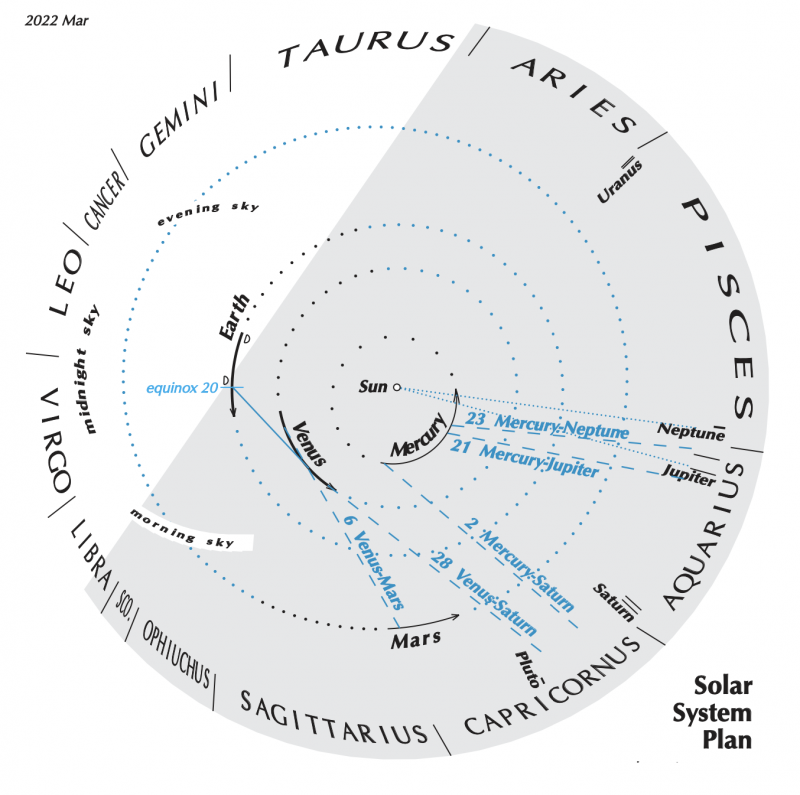
The lord's day-centered chart below comes from Guy Ottewell. Y'all'll discover charts like these for every calendar month of 2022 in his Astronomical Calendar. Guy Ottwell explains:
In these views from ecliptic north, arrows (thinner when south of the ecliptic plane) are the paths of the four inner planets. Dots along the residue of the orbits are 5 days apart (and are blackness for the function of its grade that a planet has trodden since the first of the year). Semicircles show the sunlit side of the new and full moon (vastly exaggerated in size and altitude). Pairs of lines point outward to the more remote planets. Phenomena such as perihelia (represented by ticks) and conjunctions (represented by lines between planets) are at dates that tin can be constitute in the Astronomical Calendar. Greyness covers the half of the universe below the horizon around x p.m. at mid- month (as seen from the equator). The zodiacal constellations are in directions from the Earth at mid-month (not from the sun).
View larger. | Heliocentric view of solar organisation, March 2022. Nautical chart via Guy Ottewell.View larger. | Heliocentric view of solar arrangement, April 2022. Nautical chart via Guy Ottewell.View larger. | Heliocentric view of solar system, May 2022. Chart via Guy Ottewell.
Some resource to enjoy
Don't miss anything. Subscribe to daily emails from EarthSky. It's free!
Visit EarthSky's All-time Places to Stargaze to find a dark-heaven location near you.
Post your night heaven photos at EarthSky Community Photos.
See the indispensable Observer'due south Handbook, from the Royal Astronomical Society of Canada
Visit Stellarium-Web for precise views from your location
Visit TheSkyLive for precise views from your location
The Erstwhile Farmer's Almanac provides specific planet rise and set info (U.Due south. and Canada)
Timeanddate.com provides specific planet rise and set info (worldwide)
Translate Universal Time (UTC) to your time
Read: Ecliptic is the sun's path in our sky
Read: Planet-observing is easy. Meridian tips here
Dorsum by popular demand! Guy Ottewell's Astronomical Calendar for 2022
Slap-up resource and beautiful wall nautical chart: Guy Ottewell's zodiac wavy chart
Guy Ottewell'southward Zodiac Wavy Chart is a 2-past-3 foot poster displaying the movements of the sunday, moon and planets throughout the twelvemonth. You can purchase it here.
Lesser line: Where have all the planets in the evening heaven gone? In early March 2022, they've all shifted to the morning sky. Visible planets and more, here.
Assist EarthSky keep going! Donate now.
John Jardine Goss
View Manufactures
About the Author:
"I can sometimes meet the moon in the daytime" was a cosmic revelation that John Jardine Goss first discovered through personal observations when he was 6 years old. It shook his immature concept of the universe and launched his involvement in astronomy and stargazing, a fascination he still holds today. John is past president of the Astronomical League, the largest U.Due south. federation of astronomical societies, with over xx,000 members. He's earned the title of Primary Observer and has authored the angelic observing guides Exploring the Starry Realm and Carpe Lunam. John also writes a monthly stargazing column, Roanoke Skies, for the Roanoke Times, and a bimonthly column, Skywatch, for Bluish Ridge Country mag. He has contributed to Heaven and Telescope magazine, the IDA Nightscape, the Astronomical League'due south Reflector magazine, and the RASC Observer's Handbook.

0 Response to "When Will the Moon Be at Right Ascension 6 Hours 42 Minutes and 12 Seconds Again"
Post a Comment